AI Marketing Automation for Small Businesses
Small businesses should not automate marketing everywhere. They should automate the delay between a real signal and the next useful action.
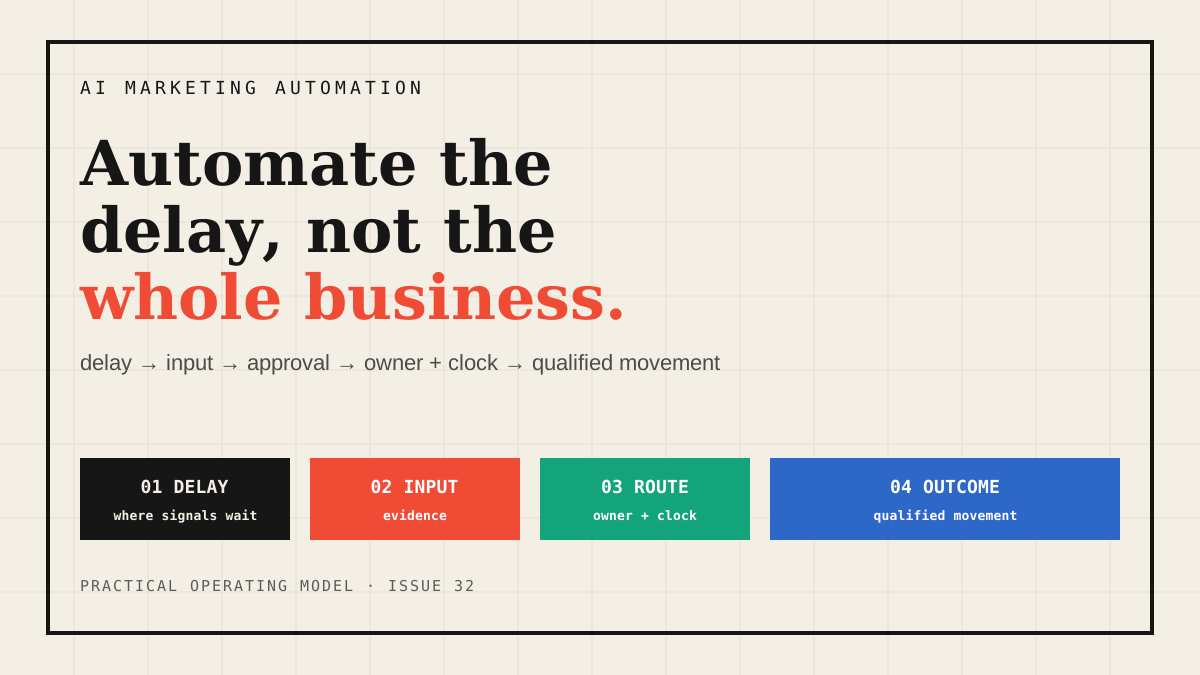
The case study
A small-business marketing system with limited time, uneven demand and a growing pile of follow-up, content and reporting work. The model below separates work AI can accelerate from decisions a human still owns.
The situation
The usual automation mistake is starting with a channel: automate email, generate social posts, connect a CRM, add a chatbot. The business becomes faster at producing activity, but nobody can say which activity moved a buyer closer to a decision.
A better starting point is the delay. Where does useful information arrive and then wait? A buyer asks a question, a sales call reveals an objection, a lead fills a form, or an old opportunity goes quiet. That signal should create a short chain: understand it, produce the right response, assign an owner and check what happened.
This is a model, not a claimed client result. It is designed to be usable with a small team: one source of truth, one approval point for commercial claims and one weekly review of qualified movement.
What they did
- 1Choose one delay: start with the gap that is closest to money, such as slow first response, repeated content production or leads with no next owner. Do not automate three gaps at once.
- 2Define the input: record the exact signal the system receives, such as form fields, a call note, an unanswered question or a lead that has been idle for seven days. If the input is vague, the output will be vague.
- 3Let AI prepare, not decide: use it to classify the signal, draft a response, extract the buyer's problem and suggest the next action. A human approves pricing, promises, proof and sensitive customer replies.
- 4Create a route: every output needs a source, intent, owner and deadline. A drafted reply sitting in a shared inbox is not automation; it is a new queue.
- 5Measure the delay and the outcome: track time to first useful response, follow-up completion, qualified conversations and opportunities created. Stop or change the workflow if output increases but qualified movement does not.
The first automation scoreboard
Before / after
Find the first delay worth automating
Reply "DELAY" with the point where a buyer signal currently waits. I will help you map the smallest useful workflow. Free, no call.
Reply DELAY →